Athleticism development for young athletes
Athleticism development is the practice of building movement skills that children can use in sports and active play. See how coaches build strength, speed, agility, and body control over time, what to watch for when choosing a class, and how to see if the training is helping.
When can children start building athleticism?
Children can build athleticism through play before they join a team or take a class. Hopping, balancing, and playing catch help them get comfortable moving in different ways. The U.S. National Youth Sports Strategy calls the ability and confidence to use those skills across activities physical literacy.
When choosing a class, use the age range to find an option and ask what your child would try first. Children develop at different rates, so look for activities that fit their current skills. Read the American Academy of Pediatrics’ guidance on sports readiness.
- Ages 2–5. Look for time to explore and short demonstrations your child can copy. Compare first sports classes in Bowie.
- Ages 6–7. Look for a class that gives your child time to practice one skill at a time. In beginner Tornadoes gymnastics, they can work on rolls and controlled landings. See beginner gymnastics.
- Ages 8–15. A coach can help your child work toward a goal such as landing a jump in balance. Fit & Flip has Cyclones classes for ages 8–11 and 12–15. Find a first Fit & Flip class.
- Ages 16–17. Ask what the coach works on with high school athletes and how the sessions fit around practices and games. Compare Bowie training for high school athletes.
How athletic development fits alongside youth sports
At basketball practice, a player learns to read a defender and decide when to pass. In an athletic development class, they can spend time on the movement underneath that play, such as stopping under control before changing direction. A gymnast uses a similar skill when they slow down into a steady landing.
Strength helps athletes produce and absorb force. Explosiveness helps them use it quickly for a first step or takeoff. Body control helps them stay balanced and organized as they move. These qualities work together across sports, and each sport still needs practice of its own skills.
Children who aren’t on a team can start with active play or a coached class they enjoy. For nearby choices, see our guide to Bowie youth sports.
Athletic training during and between sports seasons
Before adding a class, put practices, games, PE, and other activities on one calendar. Leave time for rest and tell the training coach what the full week looks like. The American Academy of Pediatrics emphasizes balancing how much young athletes train with enough time to recover.
- During a busy season. If a basketball player has team practice and a weekend tournament, ask the coach whether to keep the session light or skip it that week. If they train, they might rehearse a familiar balanced stop at a comfortable pace.
- Between seasons. With fewer team commitments, ask your child to pick one movement to build. A coach can use that same balanced stop as a starting point and add a change of direction once the athlete can repeat it consistently.
The week’s schedule helps the coach decide when to keep a movement familiar and when to progress it. See how a coach could use that approach in a Fit & Flip class. For older teens, compare sports training for ages 16–17 near Bowie.
Eight qualities of youth athleticism
Vortex’s Athleticism Accelerator framework names eight qualities coaches develop. One movement can involve several of them. For example, landing a jump takes both strength to absorb force and balance to stay steady.
- Strength. Produce and resist force. A child might practice lowering and standing in a bodyweight squat before a coach adds resistance.
- Explosiveness. Use force quickly. A coach might ask a child to take off crisply in a short jump and rest before the next attempt.
- Speed. Move quickly with consistent technique. A coach might watch the first few steps of a short sprint to see what stays steady as the child accelerates.
- Agility. Slow down, redirect, and respond to a cue. A child might learn a planned turn before reacting to the coach’s signal for which way to go.
- Flexibility and mobility. Reach a useful position and control it. A coach might use a shallow lunge with a reach, then adjust the depth as the child gains control.
- Balance. Maintain or regain stability. A child might step onto one foot and practice getting steady enough to hold the position.
- Coordination. Time the movement of different body parts. A coach might use skipping to help a child match the rhythm of their arms and legs.
- Body control. Manage where the body is in space. A child might learn to hold a tucked shape through a roll and finish in a stable position.
See how Vortex teaches youth strength training in Fit & Flip.
How coaches introduce youth plyometrics
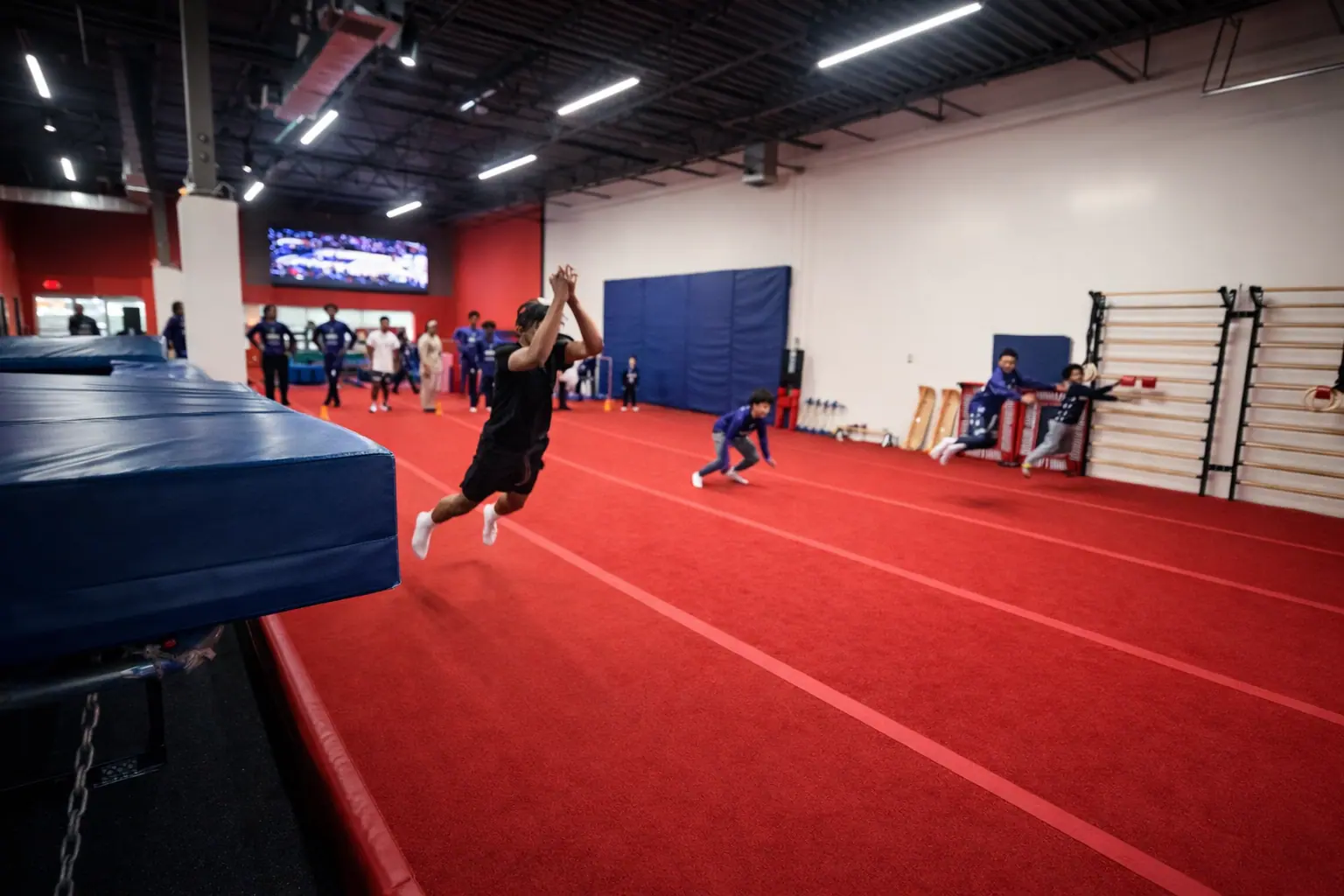
Plyometrics help athletes produce force quickly. In a rebound hop, for example, the muscles absorb force as the feet touch down and quickly produce force for the next takeoff. A coach can change how demanding the drill is by changing the height, speed, or number of contacts.
Vortex’s coaching library includes a jump-and-hold progression. An athlete starts by landing and holding their balance. Once they can repeat that landing, the coach may introduce one small rebound and ask for a steady finish. If the athlete loses balance, the coach can go back to the simpler landing.
If you’re choosing a class, ask what the coach wants to see before moving your child to faster or more demanding jumps, and how they adjust when landings change as your child tires. Read the NSCA’s guidance on youth training. See how Fit & Flip teaches jumps and landings or find a first class for ages 8–15.
How speed and agility show up in youth sports
In a straight sprint, an athlete knows where they’re going. In basketball, a defender reads the other player, chooses a direction, and then pushes off. Vortex’s coaching library works on those demands in three ways.
- First-step acceleration. In a two-point start, the coach watches whether the athlete pushes into their first two steps without rocking backward. See how a coach can check progress on a sprint start.
- Planned change of direction. The athlete knows the marked exit before they run. The coach watches whether the athlete slows before the cone and pushes off along that path.
- Reactive agility. In a mirror shuffle, the athlete follows the coach’s first sideways movement and responds when the coach reverses direction. The coach can see whether the athlete reads each cue and finishes with a controlled stop.
A defender can practice braking in the gym, then learn which movements to read from an opponent in team practice. Researchers also use separate tests for planned and reactive agility in youth team sports. See the study on reactive agility in young athletes.
Speed and agility for youth soccer
When a loose ball deflects, a player may need to push off quickly, slow down, and turn to reach it. In a conditioning class, a coach can rehearse that movement with a short start and a turn at a cone. Watch for the athlete’s plant and push away from the cone. See a change of direction in the Vortex training film.
How players slowed down and sped up again helped explain their times on a direction-change test in a study of junior high soccer players. In soccer practice, players put those movements together with a ball touch and a decision about where to dribble or pass. See Bowie FC’s soccer skills programs.
For coached strength, jumps, and movement work alongside soccer, Fit & Flip has Cyclones groups for ages 8–11 and 12–15 in Bowie. See weekly Fit & Flip times for both age groups.
How Vortex coaches progress a movement
Vortex uses four stages to teach movement. Here’s how a coach might take one athlete from a balanced stop to changing direction on a cue.
- Control. The athlete approaches a line at an easy pace and comes to a balanced stop.
- Produce. The coach asks for a quicker start from the same spot and checks whether the athlete can keep the stop steady.
- Redirect. The athlete slows, plants, and changes direction toward a cone chosen in advance.
- React. The athlete approaches the same area and responds when the coach signals which of two cones to move toward.
The coach changes one demand at a time once the athlete can repeat the movement with control. Two children of the same age may practice different versions at the same station based on what each can do consistently.
What if my child’s balance changes during a growth spurt?
The American Academy of Pediatrics notes that a growth spurt can affect balance and coordination. If your child has trouble with a landing they usually control, tell the coach which movement changed. The coach might switch to a smaller hop and ask your child to pause on two feet after landing before increasing the height. Read the American Academy of Pediatrics’ sports-readiness guidance.
When is a child ready to start strength training?
Look at how your child responds to instruction. Can they listen to a coach’s directions, wait for their turn, and try an adjustment when the coach gives feedback? A qualified coach can match the exercise to the child’s current ability and start with bodyweight movements, such as a squat. Read more in the American Orthopaedic Society for Sports Medicine’s youth strength training guidance.
Do kids need weights to get stronger?
The CDC lists climbing and gymnastics as ways younger children build strength through play. In a coached class, a child can get feedback on one movement and practice it before increasing the difficulty. CDC guidance on age-appropriate activity
What coaches look for before adding weight
A coach might teach a hip hinge by having an athlete move their hips back, then stand tall again. The coach watches whether the athlete can repeat the motion while keeping their balance and controlling the return to standing. Once the motion is consistent, the coach might add a light kettlebell for a controlled lift and lower, then check whether the movement stays steady. Read the American Academy of Pediatrics’ guidance on adding resistance.
A kettlebell swing uses the hip hinge to produce power. Watch how the athlete straightens at the hips to move the weight. See a kettlebell swing in the Vortex training film.
At Vortex, Fit & Flip has Cyclones groups for ages 8–11 and 12–15. Ask the coach what movement your child would start with. See Fit & Flip options for beginners.
What to watch for in a first class
Look for a coach who explains the task, watches your child try it, and makes a useful adjustment. The American Academy of Pediatrics emphasizes proper technique and qualified supervision in youth strength training. In practice, you can look for these signs.
- Preparation has a purpose. The warm-up rehearses a pattern athletes will use later, such as slowing into a balanced stop before adding speed.
- Difficulty matches the child. The coach can make a drill simpler or change the equipment if a child is still learning the movement.
- There’s time for feedback and recovery. Children get a clear cue and a chance to try it on the next attempt. When attempts get rushed, the coach can pause or adapt the task.
- Control comes before progression. The coach looks for a repeatable starting skill before adding speed, resistance, or a more difficult landing.
How coaches measure progress in youth athletic development
Time, distance, and weight can show one part of progress. A coach can also track whether a child can repeat the same movement with more control. The National Strength and Conditioning Association recommends evaluating both how a child moves and what the movement achieves in its position statement on long-term athletic development.
The first two steps of a sprint
In one example from Vortex’s Athleticism Accelerator coaching library, the athlete starts still with one foot ahead of the other. The coach cues them to push the floor behind them and watches the first two steps.
- Record the starting point. The coach notes how often the athlete can push forward without rocking back first or reaching for a longer step.
- Repeat the same task. On a later visit, the coach uses the same setup and cue and counts controlled starts out of the attempts the athlete makes.
- Decide what to practice next. If the athlete still reaches on most attempts, the coach can keep working on the same cue. If the push is steady more often, the coach can consider a longer start.
After class, ask the coach which movement they’d check again and what change they’d look for. Ask your child what felt easier and what they’d like to practice again.
Should my child start with a class or a performance assessment?
Start with a class if you want to see how your child responds to coaching and whether they enjoy the activities. A Fit & Flip trial is a regular 90-minute Cyclones class for ages 8–11 or 12–15. See what to expect in a Fit & Flip trial.
If you’re deciding what your child should work on next, a separate assessment can give you a starting measure. In Bowie, the GOAT Lab’s Athlete Analysis looks at speed, coordination, how the athlete moves, and readiness for strength work. See the GOAT Lab’s Athlete Analysis.
A test score reflects what an athlete did that day. Before booking, ask how the result would change what your child practices next. Read the NSCA’s guidance on youth testing.
Questions to ask a coach before enrolling
- How do you choose a starting level for a child who’s new to this type of training?
- What do you change if a movement is too hard for my child to repeat with control?
- How would you fit this class around my child’s other practices and games?
If you’re choosing a class nearby, compare youth athletic training options in Bowie and check how each program handles a first visit.